
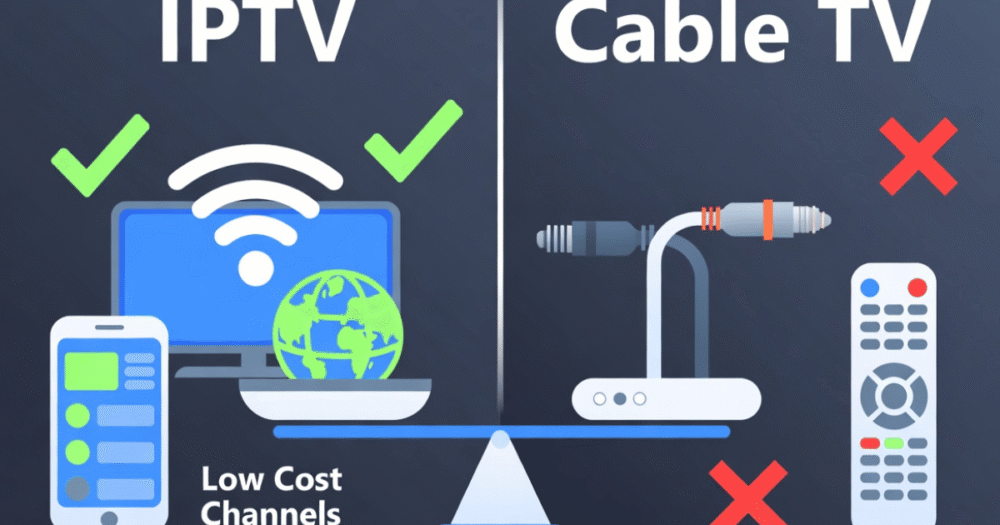
You’re Paying for Channels You’ll Never Watch
The average cable TV subscriber in the UK and US pays for over 200 channels. Research consistently shows that most households actively watch fewer than 15 of them. That’s not a service — that’s a bundle trap.
IPTV works differently. Instead of receiving a fixed broadcast signal through a coaxial cable, IPTV delivers content over your broadband connection in real time. Every stream is requested on demand, routed through content delivery servers, and played back through your chosen app — whether that’s a Smart TV, Firestick, Android box, or phone.
This isn’t just a technical distinction. It’s the reason IPTV vs Cable has become one of the most searched comparisons in the streaming space heading into 2026.
For households, the question is simple: am I getting value? For IPTV resellers, the question runs deeper — which infrastructure model actually holds up when 500 subscribers go online simultaneously on a Saturday night during a major sports fixture?
This article covers both. No generic comparisons. No recycled bullet points. Real operational insight for families making a switch and operators building a business.
How IPTV Actually Delivers a Signal (And Why It Matters)
Cable TV runs on a closed infrastructure. Broadcasters push signals through physical cables into your home. You receive whatever is on that frequency at that moment. No server requests, no routing decisions, no personalisation.
IPTV works through a completely different architecture:
- Your device sends a request to an IPTV server
- The server authenticates your subscription (via Xtream Codes or M3U protocol)
- The stream is delivered using HLS (HTTP Live Streaming) or RTSP
- Your player buffers a few seconds of data and begins playback
The critical variable here is latency. A well-configured IPTV panel with load balancing and multiple CDN nodes delivers streams with under 2–3 seconds of HLS latency. A poorly provisioned server collapses during peak demand — which is exactly when your subscribers are watching.
Cable has zero latency flexibility because it’s a broadcast model. What you see is what’s transmitted. That’s actually an advantage during live events — no buffering, no server queues. But it also means zero customisation, zero VOD integration, and zero control over your viewing experience.
Pro Tip: When evaluating IPTV vs Cable for live sports, ask the IPTV provider specifically about their load balancing architecture. A provider running on a single upstream server will always crack during peak concurrent connections — regardless of what their sales page claims.
The Real Cost Comparison: Cable Bundles vs IPTV Subscriptions
This is where most comparisons go wrong. They compare a cable TV bill to a single IPTV subscription price and declare IPTV the winner. But the honest picture is more layered.
| Factor | Cable TV | IPTV |
|---|---|---|
| Monthly Cost (average) | £40–£80 | £8–£25 |
| Contract Lock-In | 12–24 months | Month-to-month |
| Equipment Rental Fee | £5–£15/month | One-time device cost |
| Channel Count | Fixed bundle | 40,000+ with good providers |
| 4K Content | Limited | Widely available |
| VOD Library | Restricted | 190,000+ titles (premium panels) |
| Cancellation Penalty | Yes | None |
What cable providers rarely disclose upfront is the total cost of ownership — installation fees, equipment rental, mid-contract price hikes, and the cost of adding premium sport or movie packages separately. When you factor those in, the gap widens considerably.
For IPTV resellers, the margin opportunity is obvious. A reseller purchasing panel credits at £0.99–£1.50 per credit and selling monthly subscriptions at £8–£12 is operating a high-margin business at scale, with no physical infrastructure to maintain.
Where Cable Still Wins: Being Honest About IPTV Limitations
Any operator who tells you IPTV is perfect in every scenario is selling you something.
Cable TV has genuine advantages that are worth acknowledging:
- Zero dependency on internet speed. A 10Mbps broadband connection will buffer on IPTV. Cable doesn’t care about your ISP.
- No DNS poisoning risk. Cable signals can’t be blocked by ISP-level DNS interception. IPTV streams can be disrupted if providers are targeted.
- Consistent live broadcast timing. For breaking news and live sport, cable’s broadcast architecture means no stream delay — what’s happening is what you’re watching.
- No app dependency. Cable boxes are simple. IPTV requires compatible hardware and occasional troubleshooting.
For elderly users or households with unreliable broadband, cable remains genuinely easier to use. An honest IPTV reseller acknowledges this rather than overselling.
Pro Tip: If a potential subscriber has broadband speeds below 25Mbps on a shared connection, recommend they resolve their internet situation before purchasing IPTV. A bad first experience kills renewals permanently.
ISP Blocking in 2026: The Threat IPTV Users Don’t See Coming
This is where the conversation gets operational.
In 2026, ISP-level enforcement against IPTV streams has matured significantly. Major broadcasters and rights holders work directly with ISPs to implement:
- DNS poisoning — redirecting IPTV server domain requests to dead ends
- Deep packet inspection (DPI) — identifying IPTV traffic patterns and throttling or blocking them
- Server blacklisting — blocking known IP ranges associated with IPTV infrastructure
Cable TV faces none of this because it operates on a licensed, closed broadcast model.
This doesn’t make IPTV unusable — but it means resellers and subscribers need to understand what good infrastructure looks like:
- Providers with backup uplink servers automatically reroute streams when a primary IP is blacklisted
- Panel systems with DNS rotation update server addresses frequently to stay ahead of blocking waves
- VPN-ready setups give subscribers an additional layer of protection at the device level
The resellers who survived the 2023–2025 enforcement waves weren’t the ones with the cheapest panels. They were the ones operating with providers who had redundant infrastructure already in place. Platforms like British Seller document these infrastructure standards openly — worth reading before committing to any wholesale provider.
Why IPTV Wins for Resellers: The Business Logic Cable Can’t Touch
Cable TV has no reseller model. You can’t buy cable subscriptions at wholesale and resell them. The entire distribution chain is controlled by the provider.
IPTV fundamentally changes that business model. A reseller operating through a panel system can:
- Purchase credits in bulk at wholesale rates
- Activate, renew, and manage customer subscriptions from a single dashboard
- Set their own pricing and control their own margins
- Scale from 10 customers to 500 without changing their infrastructure investment
The panel credit model is the core engine. On a properly structured panel, one credit equals one month of service for one customer. A reseller purchasing 100 credits and selling each subscription at a 3× margin generates consistent monthly recurring revenue with no overheads beyond the panel cost itself.
That said, the resellers who fail are almost always the ones who ignored two variables: customer churn and server reliability. If your upstream provider can’t maintain uptime during peak hours, your customers leave — and they don’t come back.
Understanding how an IPTV reseller panel works before you invest is essential. The mechanics of credit allocation, line management, and server failover determine whether your business survives its first busy weekend.
IPTV vs Cable for Families: What Actually Matters Day-to-Day
Household buyers don’t think in terms of HLS latency or DNS infrastructure. They think in terms of specific questions:
Will it work on my Smart TV? Premium IPTV services support Firestick, Samsung and LG Smart TVs, Android boxes, Apple TV, and smartphones via compatible apps like IPTV Smarters Pro or a custom branded app.
Can multiple people watch at the same time? Most resellers offer multi-connection subscriptions — typically 1 to 4 simultaneous streams. Cable boxes are room-specific and require additional hardware per TV.
What happens if something goes wrong? With cable, you call the provider and wait. With IPTV, a good reseller resolves issues at panel level — refreshing lines, switching servers — often within minutes if they’re operating through a provider with 24/7 support infrastructure.
Is the catch-up and VOD library actually useful? Quality IPTV panels offer up to 4-day replay on major channels and a VOD library exceeding 190,000 titles. Cable catch-up is provider-dependent and usually restricted to 7 days on selected channels only.
Pro Tip: When onboarding family subscribers, set the expectation that their broadband connection is the single most important variable. A 4K stream requires around 25Mbps dedicated. If the household has 5 devices competing for bandwidth, picture quality will degrade — that’s an internet issue, not an IPTV issue.
Scaling from 10 to 500 Subscribers: What IPTV Resellers Need to Know
Growing a subscriber base sounds straightforward. In practice, the bottleneck almost never comes from marketing — it comes from support load and server stability.
At 10–50 subscribers, most resellers manage manually. One WhatsApp group, one panel dashboard, panel credits renewed monthly.
At 100+ subscribers, the gaps appear fast:
- Customers experience buffering simultaneously (server-side load issue, not individual)
- Support messages spike during live sport events
- Renewal tracking becomes a spreadsheet nightmare
- Customers churning because an issue wasn’t resolved within the hour
The resellers who scale successfully use providers with multi-server failover (automatic switching in under 3 seconds when a server drops), real-time channel monitoring tools to detect stream failures before customers report them, and no credit expiry policies so bulk purchasing doesn’t carry deadline risk.
IPTV services built for reseller growth treat infrastructure reliability as a non-negotiable rather than a premium add-on. That distinction becomes obvious at scale.
The IPTV vs Cable debate, from a reseller perspective, is actually no debate at all. Cable has no reseller model. IPTV, run correctly, is a margin-positive, low-overhead, scalable business.
Frequently Asked Questions
Is IPTV better than cable for watching live sport?
For live sport, both have trade-offs. Cable delivers a pure broadcast signal with zero server delay, making it consistent during major fixtures. IPTV offers far more coverage — including international leagues and pay-per-view events — but stream quality depends heavily on your provider’s server infrastructure and your broadband speed. A well-provisioned IPTV service with backup servers outperforms cable on content range, if not always on raw latency.
How much bandwidth do I need for IPTV to replace cable?
For a single HD stream, 10–15Mbps is workable. For 4K, you need at least 25Mbps dedicated to that stream. If your household has multiple devices online simultaneously, you need a broadband package with enough headroom to cover all concurrent usage. Cable has no bandwidth requirement because it’s a broadcast, not an internet service.
Can IPTV be blocked by my ISP?
Yes. In 2026, ISP-level enforcement includes DNS poisoning and deep packet inspection that can disrupt or block certain IPTV streams. Quality providers counter this with DNS rotation, IP failover systems, and VPN compatibility. If your provider has only one upstream server with no backup, a single enforcement action can take your entire service offline.
What is the difference between M3U and Xtream Codes for IPTV?
M3U is a playlist file format that contains stream URLs — it’s simple and widely compatible but offers less control. Xtream Codes is a panel-based login system (username, password, server URL) that allows providers to manage subscriptions, connection limits, and expiry dates from a central dashboard. For resellers, Xtream Codes is the standard because it allows precise subscription management at scale.
Is IPTV cheaper than cable in the long run?
Significantly. Cable subscriptions average £40–£80 per month with contract lock-ins and equipment rental fees. Quality IPTV subscriptions run £8–£25 per month with no contract. For resellers, the per-credit wholesale cost drops further with volume purchasing, making the margin per subscriber much higher than any traditional cable resale model could offer.
Can I run an IPTV reseller business from home?
Yes. The panel-based reseller model requires no physical infrastructure. You purchase credits, manage subscriptions through a dashboard, and handle customer communication — all remotely. The main operational requirements are a reliable panel provider, a basic understanding of how subscriptions and line management work, and responsive support access for troubleshooting.
What should I check before choosing an IPTV provider over cable?
Verify the provider’s uptime record, server redundancy (minimum 3 backup servers with automatic failover), channel stability during peak hours, and support response time. A provider who can’t demonstrate infrastructure resilience will cost you customers during the moments that matter most — major live events.
Is IPTV suitable for large households with multiple TVs?
Yes, provided the subscription includes multiple simultaneous connections and your broadband has sufficient capacity. A 4-connection IPTV subscription can serve four TVs concurrently. Cable requires a separate box and often a separate subscription tier for each additional TV — making IPTV considerably more cost-efficient for larger households.
IPTV Reseller Success Checklist
Use this before you commit to any provider or scale your operation:
- Confirm your wholesale provider operates a minimum of 3 backup uplink servers with automatic failover
- Test streams during peak hours (Saturday evening, live sport fixtures) — not just on a Tuesday afternoon
- Understand the credit model before purchasing — confirm no expiry limits on unused credits
- Set subscriber expectations around broadband speed requirements before activation
- Build a basic renewal tracking system from day one — manual management breaks at 50+ users
- Establish a support response protocol — know who you’re escalating to when a server issue hits at midnight
- Price your subscriptions with a churn buffer — assume 15–20% monthly churn and model your margins accordingly
- Visit iptvservices.ltd/services/ to review what a structured service offering looks like at operator level
- Read the full breakdown at iptvservices.ltd/how-iptv-reseller-panel-works/ before scaling past 100 subscribers
- Review reseller panel structures and pricing benchmarks at britishseller.co.uk to calibrate your wholesale costs against market rates