
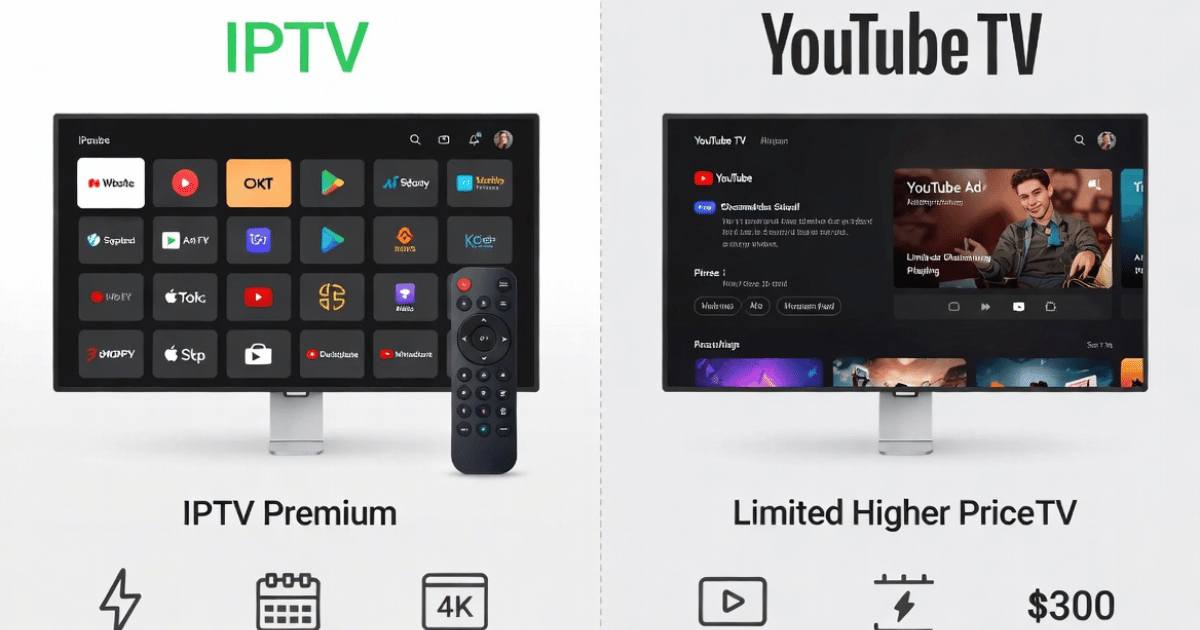
IPTV vs YouTube TV: Which Should You Actually Choose in 2026?
You have two tabs open. One shows a YouTube TV plan at $82.99 a month. The other shows an IPTV subscription for a fraction of that — 40,000+ channels, 4K, no contract.
They both stream to the same television. They both need internet. But they are not the same product, built for the same person, or delivering the same experience under pressure.
The IPTV vs YouTube TV decision is not about which one sounds better on paper. It is about your household, your risk tolerance, your budget, and whether you want to build a reseller business or simply watch TV. This guide gives you the unfiltered breakdown — costs, infrastructure, control, and real-world tradeoffs.
The Core Difference Between IPTV vs YouTube TV Nobody Explains Clearly
YouTube TV is a licensed, US-only live TV streaming service operated by Google. The base plan costs $82.99 per month and covers 100+ channels including local networks, sports, news, and entertainment. It functions as a direct replacement for cable — familiar, regulated, and heavily limited to the US market.
IPTV operates on a completely different model. Streams are delivered over internet protocol directly to your device through a reseller panel or subscription line, providing access to global content across live channels, sports, on-demand libraries, and premium events — typically without geographic restriction.
The result is a fundamentally different product:
- YouTube TV — licensed, regulated, US-only, limited to 3 simultaneous streams per household, fixed channel list
- IPTV — global content access, multi-device, reseller-capable, flexible pricing, infrastructure-dependent
Neither is universally better. What matters is which architecture matches what you actually need.
IPTV vs YouTube TV: Real Cost Comparison for Households and Resellers
YouTube TV’s 2026 overhaul introduced 10+ genre-specific tiers, with the Sports Plan starting at $64.99 per month and the Entertainment Plan beginning at $54.99 per month. On the surface, that looks more affordable. In practice, core sports access still costs $65–$83 monthly, per household, with no ability to resell, share credits, or scale.
IPTV subscriptions through a reseller panel operate on a per-credit model. At the wholesale level, a single monthly line costs well under £2 in volume — meaning a household paying £10–£15 per month for a premium IPTV subscription is receiving infrastructure that costs a fraction of a YouTube TV plan, with significantly broader content access.
| Feature | YouTube TV (Base Plan) | IPTV Subscription |
|---|---|---|
| Monthly Cost | $82.99 / ~£65 | £5–£15 typical retail |
| Simultaneous Streams | 3 (household limit) | Provider-dependent |
| Global Channels | US-focused only | 40,000+ worldwide |
| Reseller Potential | None | Full panel system |
| Contract Required | Monthly (cancel anytime) | Flexible / monthly |
| Geographic Availability | US only | Worldwide |
| 4K Content | Add-on ($9.99/mo extra) | Included in most plans |
For a single household watching US content only, YouTube TV is a functional option. For anyone outside the US, managing multiple screens, or looking at reseller income — IPTV wins on economics every time.
Why YouTube TV Cannot Scale the Way IPTV Can
This is the dimension most comparison articles skip entirely. YouTube TV is a consumer product. It has no reseller tier, no panel architecture, and no mechanism for you to create subscriptions for other people.
IPTV operates through a credit-based reseller panel system that allows a single operator to manage hundreds of active lines from one dashboard. Each credit activates a subscription for one customer. The economics scale linearly — more credits, more customers, more margin.
Pro Tip: The real IPTV vs YouTube TV debate for resellers is not about which streams better. It is about which one you can build a business around. YouTube TV has no answer for that question. IPTV reseller infrastructure does — but only when you choose a provider running multi-server failover, not a single-node operation that collapses under load.
Understanding the underlying panel architecture before committing to a provider is critical. Resources like how an IPTV reseller panel works give you the technical baseline before you invest in credits.
Channel Depth: Where IPTV vs YouTube TV Diverges Completely
YouTube TV’s base plan includes 100+ channels covering local broadcast networks, sports, news, and entertainment — with unlimited cloud DVR and up to 6 user profiles. That is a solid package for a US household watching mainstream content.
IPTV delivers a categorically different content volume. Premium IPTV panels include:
- 40,000+ live channels across global markets
- 190,000+ on-demand movies and series
- Premium sports streams including international events unavailable on any US streaming service
- Pay-per-view events built into the subscription
- Multi-language content across European, Asian, Middle Eastern, and South American markets
- Catch-up and replay functionality across a 4-day rolling window
For households with international backgrounds, YouTube TV is functionally useless outside mainstream US programming. IPTV is the only practical option for anyone wanting Arabic, South Asian, European football, or non-English language content without paying for multiple separate subscriptions.
The Infrastructure Reality Behind IPTV vs YouTube TV Reliability
YouTube TV runs on Google’s global CDN infrastructure. Outages are rare and short. This is not matched by all IPTV providers — and this is where the IPTV vs YouTube TV comparison becomes honest rather than promotional.
IPTV stream quality is entirely dependent on the provider’s infrastructure decisions. A provider running multi-node load balancing with automatic failover under three seconds delivers a fundamentally different experience than one running a single origin server.
What separates stable IPTV infrastructure from unreliable operations:
- Minimum three independent uplink paths from separate data centres
- Automatic server failover triggered in under three seconds
- Real-time concurrency monitoring to prevent load-based degradation
- HLS latency management with adaptive bitrate switching during peak traffic
- DNS redundancy to prevent poisoning-based service disruption
When a reseller chooses their IPTV provider, they are effectively choosing their reliability ceiling. A provider who cannot explain their failover architecture is not ready for scale. Reliable IPTV services disclose their server structure and uptime guarantees as a baseline, not as a selling point.
How ISP Blocking in 2026 Affects IPTV vs YouTube TV Differently
This is a dimension that matters enormously and gets almost no coverage in mainstream comparison content. YouTube TV is not subject to ISP blocking. It is a licensed service delivered through Google’s infrastructure, and no ISP applies deep packet inspection to throttle or disrupt it.
IPTV operates in a different enforcement environment. In 2026, AI-assisted deep packet inspection deployed by ISPs can identify IPTV traffic patterns in real time and apply dynamic throttling or DNS poisoning without blocking IP addresses outright. The result is progressive stream degradation — not a clean block, but a slow degradation that looks like buffering to the end user.
Mitigation tactics at the provider and subscriber level:
- HTTPS stream endpoints instead of HTTP to reduce traffic detection signatures
- VPN deployment at router level to obfuscate IPTV traffic patterns
- Custom DNS configuration (8.8.8.8 or 1.1.1.1) to prevent DNS poisoning
- Provider-side IP rotation and user-agent variation to disrupt pattern recognition
Resellers operating in markets with aggressive enforcement need to factor this into their onboarding process. Customers who experience progressive buffering without understanding the cause will churn without explanation. Addressing it proactively — with setup guides that include DNS and VPN configuration — reduces preventable cancellations.
For detailed guidance on managing this for your customer base, see the full breakdown of available IPTV reseller services.
IPTV vs YouTube TV for Sports: The Premium Events Problem
YouTube TV’s integration of ESPN Unlimited at no extra cost for sports plan subscribers is scheduled for fall 2026, timed around the NFL season. That improves the sports offering meaningfully — but it remains locked to US sports broadcasting rights.
Premium international sports events — continental football leagues, international cricket tournaments, combat sports pay-per-view, motorsport — are not available on YouTube TV at any price tier. The licensing structure simply does not support it.
IPTV’s approach to premium sports is structurally different. Top-tier providers include major sports streams, pay-per-view events, and international league coverage within the base subscription. No add-ons, no seasonal tickets, no geographic blackouts.
Pro Tip: When a customer asks which is better for sports, ask them which sports. YouTube TV is the right answer for US network sports. IPTV is the right answer for everything else — and for households that want both premium sports streams and international content under one subscription at a lower total cost.
When YouTube TV Is the Right Choice
This is not an article that pretends IPTV wins in every situation. There are genuine use cases where YouTube TV makes more sense, and operators who understand this retain customers longer than those who oversell.
YouTube TV is the better choice when:
- The household only watches mainstream US broadcast content
- Legal compliance and service transparency are the primary concerns
- Cloud DVR with a guaranteed 9-month retention window is a priority
- The user has zero technical tolerance — no app configuration, no DNS setup, no troubleshooting
- The household is in the US and already uses Google ecosystem products
YouTube TV currently holds 8 million subscribers, making it the largest live TV streaming service in the US, which reflects genuine demand for a hassle-free, legally compliant cable replacement.
For everything outside that profile — international content, multi-screen households, resellers, non-US users, or budget-conscious families — IPTV delivers more for less. UK resellers looking for a reliable panel infrastructure that can be introduced to household customers can evaluate options through britishseller.co.uk’s IPTV reseller panel comparisons before committing to a provider.
Frequently Asked Questions
Is IPTV cheaper than YouTube TV in 2026?
In most cases, significantly cheaper. YouTube TV’s base plan sits at $82.99 per month, with sports-focused tiers starting at $64.99. A retail IPTV subscription through a reseller typically costs £5–£15 per month with broader channel access, 4K included, and no geographic restriction. The cost gap widens further when you factor in multi-device usage or international content needs.
Can I use IPTV vs YouTube TV outside the United States?
YouTube TV is restricted to US users only and will not function abroad without workarounds. IPTV carries no geographic restriction at the subscription level — it works on any internet-connected device worldwide. For international households or non-US users, IPTV is the only practical option between the two.
Which is better for IPTV vs YouTube TV when watching live sports?
It depends entirely on which sports. YouTube TV covers US network sports well, with ESPN, major broadcasters, and an upcoming ESPN Unlimited integration. IPTV covers international football leagues, combat sports pay-per-view, cricket, motorsport, and premium events unavailable on any US streaming licence. For global sports coverage, IPTV has no close competitor at its price point.
How does IPTV stream quality compare to YouTube TV?
YouTube TV streams via Google’s CDN infrastructure, which is highly stable. IPTV stream quality varies by provider and is entirely dependent on their server architecture, load balancing capability, and uplink redundancy. A well-infrastructured IPTV provider delivers equivalent or better quality than YouTube TV — a single-node provider with no failover will underperform badly during peak hours.
What happens if my IPTV provider goes down — is it like YouTube TV?
No. YouTube TV downtime is extremely rare and typically resolved within minutes by Google’s infrastructure team. IPTV downtime depends on your provider’s backup uplink architecture. Providers running automatic failover across multiple server nodes recover in under three seconds. Providers without it can experience extended multi-hour outages. This is the single most important infrastructure question to ask before buying or reselling IPTV.
As a reseller, can I offer IPTV instead of YouTube TV to my customers?
Yes — and it is the model used by thousands of active resellers. IPTV operates through a panel credit system that lets you create, manage, and renew subscriptions for customers from a single dashboard. YouTube TV has no reseller tier whatsoever. IPTV is the only option if you want to build a recurring-revenue streaming business rather than simply pointing customers to a Google product.
Is IPTV legal compared to YouTube TV?
YouTube TV is a fully licensed service with content agreements in place across its channel lineup. IPTV services vary — licensed IPTV services exist and operate legally, while unlicensed streams operate in grey or restricted territory depending on jurisdiction. Users should verify the status of any IPTV subscription in their region. This article does not constitute legal advice.
Can a family household use IPTV the same way they use YouTube TV?
Yes, with one important difference: setup. YouTube TV requires zero configuration beyond a Google account. IPTV requires basic device setup — app installation, entering login credentials, and optionally configuring DNS or VPN. Once configured, the day-to-day experience is comparable or superior, with more content, more devices, and lower cost. Resellers who provide a simple onboarding guide significantly reduce household support requests.
Reseller Success Checklist: Positioning IPTV Against YouTube TV
Know your prospect’s geography before your first conversation. If they are in the US and only watch mainstream networks, acknowledge that YouTube TV is a functional option. Lead with global content, cost savings, and multi-device flexibility to differentiate without overselling.
Build a one-page comparison document showing cost-per-month across YouTube TV tiers versus your IPTV retail pricing. Include channel volume, device support, and 4K availability. Let the numbers do the positioning work — you do not need to attack YouTube TV, you need to let the economics speak.
Prepare a setup guide for every device type your customers use. The only real friction IPTV has against YouTube TV is initial configuration. Remove that barrier completely and the product sells itself on price and content volume.
Audit your provider’s infrastructure before positioning their service against a Google product. If they cannot confirm multi-node failover, independent uplink redundancy, and real-time concurrency monitoring, you will lose customers at the first live sports event under heavy load.
When customers ask about ISP blocking or buffering, address it proactively. Provide DNS configuration instructions (8.8.8.8 or 1.1.1.1) and a simple VPN recommendation during onboarding. Customers who encounter degradation without preparation will compare it unfavourably to YouTube TV, even if the fix takes 90 seconds.
Track how many of your active customers were previously on YouTube TV or cable. That conversion data tells you which pain points drove the switch — and gives you the exact language to use when approaching similar prospects. High-quality panel infrastructure from providers running verified IPTV services makes that retention story significantly easier to tell.