
Most people only read an IPTV subscription refund policy after something has already gone wrong: buffering that never clears, an EPG that stopped updating, or a panel that vanished overnight. By then it’s too late to negotiate terms. The IPTV subscription refund policies that actually protect a buyer are written in plain language, tied to measurable service failures, and processed on a fixed timeline, not “case by case at our discretion.” This guide breaks down what a fair refund policy looks like from the inside, why so many providers avoid writing one at all, and what both subscribers and resellers should demand before money changes hands.
Why Most IPTV Refund Policies Are Deliberately Vague
A vague IPTV subscription refund policy isn’t an oversight. It’s a margin-protection tactic. Panel operators know that stream quality depends on backhaul capacity, ISP routing, and concurrent load at any given hour, all of which shift daily. A provider that promises a firm, no-questions-asked refund is committing to compensate for infrastructure problems it doesn’t fully control. So instead, most policies use phrases like “reviewed individually” or “subject to management approval,” which sound reasonable but give the seller total control over the outcome.
This matters because IPTV subscription refund policies are one of the few consumer-facing signals a buyer has before committing. A provider with nothing published, or a one-line disclaimer buried in checkout, is signaling that disputes will be handled reactively rather than by rule. That’s not automatically a scam, but it does shift all the risk onto the buyer.
Pro Tip: Before buying, search the provider’s own site for the word “refund.” If it only appears in a general terms-of-service page and not as its own section, treat that as a pricing risk, not just a policy gap.
The providers worth trusting usually separate refund terms from general terms of service entirely, because they expect the question to come up often enough to warrant its own page.
What a Fair Refund Window Actually Looks Like
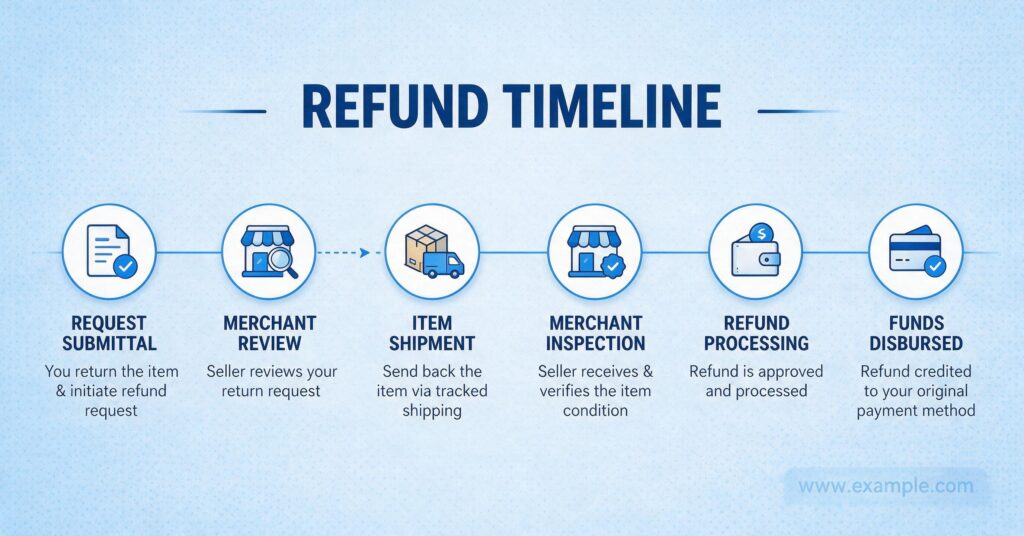
A workable IPTV subscription refund policy defines three things clearly: the eligible window, the qualifying failure, and the payout method. Most legitimate providers offer somewhere between 24 and 72 hours from activation, tied specifically to connection failure, not dissatisfaction with channel selection or picture quality preference.
The distinction matters. A buffering issue caused by the subscriber’s own home Wi-Fi congestion isn’t the same as a panel-side outage, but plenty of policies don’t separate the two, which lets providers reject nearly every claim on a technicality. Look for policies that require a screen recording or timestamped error log rather than a written description, since that protects both sides from disputes over what actually happened.
- Eligible window stated in hours or days, not “reasonable time”
- Failure type defined (connection drop, EPG failure, server-side outage)
- Required evidence specified in advance (screenshot, error code, timestamp)
- Refund method disclosed (credit, partial credit, or cash reversal)
- Processing time given as a number, not “as soon as possible”
If a provider can’t answer these five points in one paragraph, the policy exists mostly for appearances.
Store Credit vs Cash Refunds: The Difference Resellers Don’t Advertise
Store credit is the default refund mechanism across most IPTV subscription refund policies, and it’s rarely the buyer’s first choice. Credit keeps revenue inside the platform and avoids payment processor chargeback flags, which is why so many resellers default to it even when a cash reversal would be simple to process.
For a subscriber, store credit isn’t inherently unfair, but it does mean accepting continued exposure to the same provider whose service just failed. For a reseller managing sub-resellers, credit-based refunds also complicate commission tracking, since a refunded credit line still needs to be reconciled against monthly panel costs even though no new revenue was generated.
| Refund Type | Speed | Risk to Provider | Fairness to Buyer |
|---|---|---|---|
| Cash reversal | Slower (bank processing) | Higher (real revenue loss) | Highest |
| Store credit | Instant | Low | Moderate |
| Partial credit + partial cash | Moderate | Balanced | Depends on split |
| Panel-to-panel transfer | Fast | Low | Low unless requested |
A policy that only offers store credit, with no cash option even for total service failure, is optimizing for retention over fairness. That’s worth knowing before the first payment, not after the first outage.
How Chargebacks Change the Refund Conversation Entirely
Once a subscriber files a payment processor chargeback instead of requesting a refund directly, the IPTV subscription refund policy becomes irrelevant. Chargebacks bypass the provider’s own terms and go straight to the payment network’s dispute process, which is why experienced resellers treat chargeback prevention as a separate discipline from refund policy writing.
A reasonable refund window, honored consistently, is the single best chargeback deterrent available. Subscribers escalate to chargebacks when they feel a direct request will be ignored or delayed past a payment dispute deadline, which is usually 60 to 120 days depending on the card network. Providers who process refund decisions within 48 hours rarely see chargeback rates climb, regardless of channel lineup or price point.
Pro Tip: Track refund request response time as its own metric, separate from refund approval rate. A provider can approve 90% of requests and still get flooded with chargebacks if the average response time exceeds a week.
For resellers managing multiple sub-reseller lines, a chargeback against one panel credential can trigger reserve holds across the whole merchant account, which is a far bigger operational risk than the individual refund itself.
Trial Periods Are Not the Same as Refund Policies
A common source of confusion in IPTV subscription refund policies is treating a free or discounted trial as equivalent to a refund guarantee. They serve different purposes. A trial period exists to demonstrate stream stability before full payment; a refund policy exists to remedy a failure after payment has already been made.
Providers sometimes blur this deliberately, offering a “trial-based satisfaction guarantee” that quietly excludes anyone who paid full price upfront. Subscribers should check whether the refund terms apply equally regardless of which pricing tier or promotional offer was used at signup, since two-tier refund eligibility is a common way to shrink the pool of buyers who actually qualify.
- Confirm whether refund eligibility changes based on discount codes used
- Check if annual plans have different refund terms than monthly plans
- Ask whether a trial conversion resets the refund eligibility clock
- Verify if bulk reseller credits follow the same refund rules as single subscriber accounts
None of this is unusual in subscription businesses generally, but IPTV’s operational volatility (server migrations, ISP-level throttling, DNS-level blocking) makes the fine print matter more than it would for, say, a static software license.
What Sub-Reseller Refund Chains Actually Look Like
In a multi-tier IPTV reseller network, a refund request rarely starts and ends in one place. A subscriber requests a refund from a sub-reseller, who requests credit back from the reseller above them, who in turn may need to draw against panel-level credits with the upstream infrastructure provider. Each layer adds delay, and each layer can quietly absorb or reject part of the claim before it reaches the top.
This is where IPTV subscription refund policies matter most for the middle tiers, since a sub-reseller with no written policy of their own is exposed to whatever their upstream decides, with no protection for their own margin. A sub-reseller operating without a documented refund process is effectively guaranteeing subscriber refunds out of pocket whenever the upstream panel is slow to respond or declines the claim outright.
Pro Tip: If you operate as a sub-reseller, negotiate your own refund turnaround time with your upstream reseller in writing before onboarding subscribers. Verbal assurances don’t hold up when a dispute reaches the third tier of a reseller chain.
The resellers who scale successfully treat refund policy as infrastructure, not customer service, because the alternative is absorbing losses that should sit further up the credit chain.
Backup Uplinks and Why They Reduce Refund Volume
Every IPTV subscription refund policy exists downstream of infrastructure decisions, and backup uplink servers are one of the clearest examples. A provider running a single origin server with no failover is betting that outages stay short enough that refund requests remain manageable. When a primary server goes down during a high-demand period, without a backup uplink to shift traffic to, refund requests spike all at once, which strains both support capacity and cash reserves simultaneously.
Providers that invest in redundant uplinks and load-balanced distribution see materially lower refund volume, not because their policy is more generous, but because fewer subscribers experience a qualifying failure in the first place. This is worth mentioning to subscribers directly: a generous refund policy paired with unstable infrastructure is a worse deal than a stricter policy backed by consistent uptime.
For resellers evaluating which panel to build on, refund policy design should be reviewed alongside uptime history and failover architecture, not as a separate checklist item. A refund policy is a symptom of how the underlying infrastructure is managed, not an independent feature.
AI-Driven ISP Blocking and Its Effect on Refund Disputes
Heading into 2026, ISP-level blocking has grown more adaptive, with some networks now using AI-assisted traffic pattern detection to flag and throttle IPTV-style connections rather than relying purely on static IP blacklists. This changes the refund conversation in a specific way: a connection that worked perfectly at signup can degrade weeks later due to an ISP policy change entirely outside the provider’s infrastructure.
A well-written IPTV subscription refund policy should distinguish between provider-side failures and ISP-side interference, since conflating the two either overcompensates subscribers for issues the provider can’t fix, or leaves subscribers without recourse for issues the provider could mitigate with DNS rotation or alternate routing. Providers who offer troubleshooting steps (alternate DNS, backup server switching) before processing a refund tend to resolve more disputes without a payout at all, which benefits both sides when the underlying connection issue is fixable.
- Ask if the provider offers DNS alternatives before refund escalation
- Confirm whether repeated ISP-side blocking is treated as a refund trigger or a routing fix
- Check if the policy differentiates rural/regional ISP issues from major carrier blocking
This distinction is becoming a standard clause in updated 2026 refund policies, and its absence is a reasonable question to ask directly before subscribing.
Frequently Asked Questions
Do IPTV subscription refund policies cover buffering issues specifically?
Most policies only cover buffering if it’s tied to a provider-side outage confirmed by server logs, not general playback quality. Home network congestion, device limitations, and ISP throttling are usually excluded unless the policy explicitly states otherwise.
How long do IPTV subscription refund policies typically stay in effect after signup?
Most providers set a window between 24 and 72 hours from activation. A small number extend this to seven days for annual plans, though that’s less common and worth confirming directly with the provider.
Can I get a cash refund instead of store credit?
Some providers offer this, but many default to credit unless the failure is a confirmed total outage. Ask before paying whether cash reversal is available at all, since it’s rarely advertised upfront.
What happens if my sub-reseller won’t honor a refund?
Escalate to the reseller or panel above them in writing, and keep timestamped evidence of the original failure. If no resolution follows within a reasonable window, a payment processor dispute becomes the fallback option.
Is it normal for refund requests to take more than a week to process?
No. Response time beyond a week is a signal of poor internal process rather than a complicated case. Faster providers typically respond within 48 hours regardless of approval outcome.
Why do some providers exclude trial subscriptions from refund policies?
Trials exist to test stability before commitment, so providers treat them as inherently lower-risk and often non-refundable by design. This is standard practice and not usually a red flag on its own.
Do refund policies differ between monthly and annual IPTV plans?
Yes, in many cases. Annual plans sometimes carry a longer refund eligibility window since the financial commitment is larger, but this isn’t universal and should be confirmed before purchase.
As a reseller, how do I protect my margin from refund chargebacks?
Negotiate refund turnaround terms with your upstream provider in writing, track response times separately from approval rates, and require the same evidence standard (timestamps, error logs) from your own subscribers that you’d expect from your upstream.
Subscriber Checklist
- Confirm the refund window in hours or days, not vague language
- Ask whether cash reversal is available, not just credit
- Save timestamped evidence from the first sign of connection trouble
- Check if trial and paid-tier refund terms differ before signing up
Reseller Checklist
- Publish a standalone refund policy page separate from general terms
- Track refund response time as its own metric, not just approval rate
- Offer troubleshooting (DNS switch, server change) before processing refunds
- Review refund volume against uptime data monthly, not reactively
Sub-Reseller Checklist
- Get refund turnaround terms from your upstream in writing before onboarding subscribers
- Never promise faster refund timelines than your upstream can actually deliver
- Keep your own evidence log independent of what subscribers submit
- Reconcile credited refunds against monthly panel costs, not just visible revenue
Conclusion
IPTV subscription refund policies reveal more about a provider’s operational maturity than any marketing page does. A fair policy names its window, its qualifying failures, and its payout method in plain terms, and it’s backed by infrastructure that keeps refund volume low in the first place rather than a policy that simply looks generous on paper.