
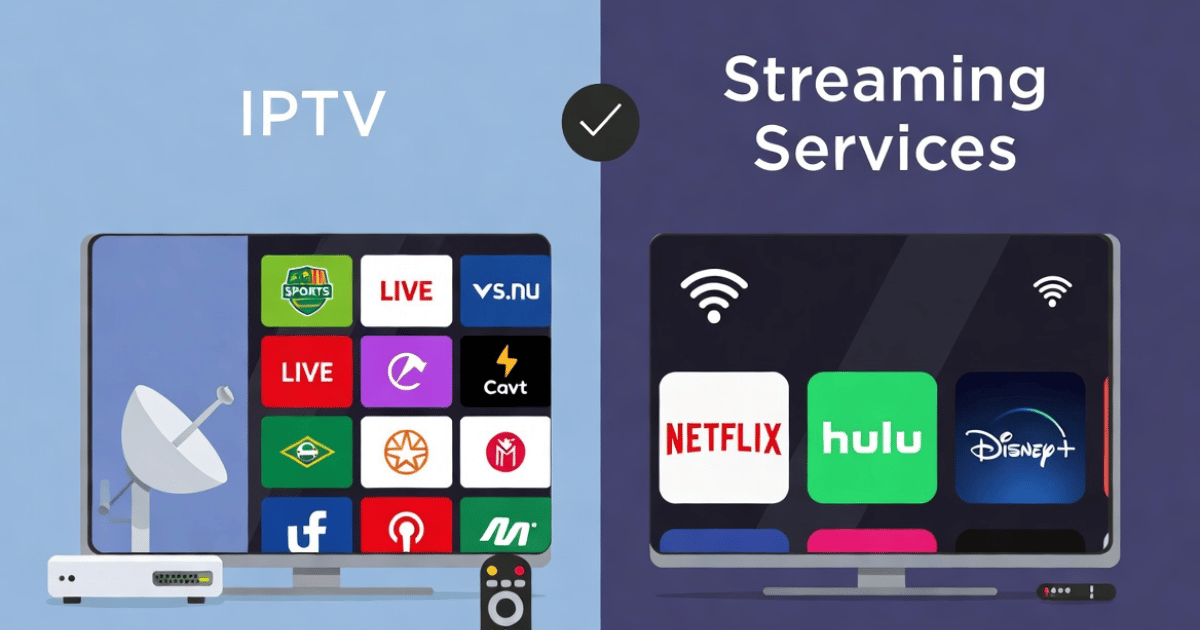
IPTV Vs Streaming Services: Key Differences
You’re paying for two things that look identical on your TV screen — but under the hood, they couldn’t be more different. Understanding the difference between IPTV and streaming services isn’t just a technical curiosity. It determines what breaks, who controls it, how much you pay, and what options you actually have when something goes wrong.
Most people assume IPTV is just another name for streaming. It’s not. The distinction matters to households managing multiple screens, and it matters even more to resellers who need to explain what they’re selling without confusing their customers into cancellations.
This guide breaks down the real difference between IPTV and streaming services — from infrastructure and delivery protocols to pricing models, content access, and what each option looks like under 2026’s AI-driven enforcement landscape.
How IPTV Delivers Content Versus How Streaming Services Do It
The fundamental difference between IPTV and streaming services is in the delivery method. It’s not about picture quality or content library size — it’s about how the data reaches your screen.
Streaming services — think on-demand platforms — use a content delivery network (CDN) that responds to your requests. You click play, the CDN finds the nearest server with that file, and it sends it to you. The content isn’t live. It’s stored. The server waits for you.
IPTV works differently. Content is pushed to you in real time across a dedicated IP network. The server doesn’t wait for your click — it continuously streams the channel, and your device tunes in. This is exactly how traditional broadcast television works, except the delivery route is your internet connection instead of a satellite or aerial signal.
The practical implication: IPTV is significantly better for live content — sports, news, events. On-demand streaming services are better for library content you want to watch on your own schedule. Most serious IPTV setups include both, which is why the comparison becomes genuinely useful only when you understand which scenario you’re evaluating.
Pro Tip: HLS latency on IPTV live streams sits between 6–30 seconds behind real broadcast time depending on your server and player settings. If a customer is watching a live match and getting spoilers from their phone, that gap is the reason — not a fault, just the architecture.
The Infrastructure Behind IPTV vs Streaming Services
This is where the difference between IPTV and streaming services becomes operationally significant — especially for resellers.
Mainstream on-demand streaming platforms run on hyperscale cloud infrastructure with thousands of CDN nodes globally. Their uptime architecture is built with redundancy at a scale most IPTV operations cannot match. When their servers have a problem, it affects millions of users simultaneously and gets fixed within minutes because the incentive is enormous.
IPTV infrastructure is different in structure and in risk profile:
- Content is delivered via dedicated server clusters, often with 3+ back up uplink servers configured for automatic failover
- Load balancing distributes concurrent connections across multiple servers to prevent overload during peak events
- DNS poisoning attacks specifically target IPTV providers — ISPs and enforcement agencies use DNS-level blocks to disrupt service
- When a server goes down without a failover in place, every customer on that server loses their stream simultaneously
For households, this means IPTV reliability is directly tied to the quality of the provider’s infrastructure — not just their content library. For resellers, it means your reputation depends on infrastructure choices your supplier made before you ever joined.
| Infrastructure Factor | On-Demand Streaming Platforms | IPTV Services |
|---|---|---|
| Server redundancy | Hyperscale, global CDN | Provider-dependent, typically 3+ failover servers |
| Uptime model | 99.9%+ enforced by scale | Quality-dependent, varies by provider |
| DNS poisoning vulnerability | Low — massive legal protection | High — primary enforcement attack vector |
| Load balancing | Automatic, cloud-native | Configured per panel, variable quality |
| Live event performance | Delayed, not optimised for live | Optimised for real-time delivery |
Content Access: What IPTV Offers That Streaming Services Can’t
This is where the difference between IPTV and streaming services becomes most visible to end users — and most commercially significant for resellers.
On-demand streaming platforms license specific content for specific regions. A US-based platform may not carry UK sports. A UK platform may not carry European football packages. Geographic licensing means no single mainstream platform gives you everything.
IPTV operates differently. A well-stocked IPTV subscription provides access to channels from multiple countries simultaneously — without switching accounts, without separate subscriptions, without geo-restrictions that block content based on your location. A family household in the UK can access sports channels, international news, and entertainment from multiple territories through one line.
The channel depth also differs significantly. Premium IPTV subscriptions from established providers carry 40,000+ live channels alongside 190,000+ on-demand titles — a catalogue that no single mainstream streaming service comes close to matching.
- Live sports from multiple territories on one subscription
- International channels in languages mainstream platforms don’t carry
- Pay-per-view events included without additional charges
- Catch-up and replay features covering the last 4 days of programming
For resellers, this content breadth is the primary commercial argument. Customers comparing a single on-demand subscription to a comprehensive IPTV package are looking at a different value calculation entirely — and understanding that difference is what converts a curious inquiry into an active panel credit spend.
Pricing Models: IPTV vs Streaming Services — What You Actually Pay For
The difference between IPTV and streaming services is perhaps most obvious in pricing structure. Mainstream streaming platforms charge per-account, per-tier, per-device. Add multiple screens, multiple family members, and the bill climbs fast.
IPTV pricing works on a per-line model. One line, one active stream. Resellers purchase panel credits in bulk — platforms like those available through established UK IPTV reseller panels offer credits at rates that make per-customer margins viable even at competitive subscription prices.
Pro Tip: The real margin in IPTV reselling isn’t on individual subscriptions — it’s on volume and retention. A customer paying monthly for 12 months is worth 3–4x a customer who churns after 2. Price your subscriptions to retain, not just to acquire. Customer churn psychology matters more than acquisition cost at scale.
For households, the comparison is straightforward: one IPTV subscription at a competitive monthly rate can replace multiple individual streaming platform subscriptions while delivering more live content. For resellers, the per-credit model means your cost of goods scales directly with your active subscriber count — no fixed overhead for unused capacity.
How AI-Driven ISP Blocking Affects IPTV But Not Mainstream Streaming
This is a dimension of the difference between IPTV and streaming services that almost no comparison guide addresses — and it’s arguably the most operationally important in 2026.
Mainstream on-demand streaming platforms operate with legal licenses. ISPs don’t block them. They have no incentive to. IPTV operates in a different enforcement environment, and that environment has changed significantly.
In 2026, ISPs across the UK, EU, and Gulf states are running AI-driven deep packet inspection that identifies IPTV traffic patterns in near real-time. The system doesn’t just block known server IPs — it analyses traffic signatures, identifies HLS stream patterns, and applies throttling or full blocks dynamically. The result is that IPTV performance on certain networks has become inconsistent in ways that have nothing to do with server quality.
Back up uplink servers matter more than ever in this environment. Providers with single-server configurations are vulnerable to enforcement sweeps in a way that multi-server setups with automatic failover are not. When a primary server gets hit by a DNS poisoning attack or an ISP block, the failover server needs to activate in under 3 seconds to keep streams uninterrupted.
For resellers sourcing infrastructure, this is a non-negotiable due diligence point. Ask your provider: how many back up uplink servers run behind your panel? What’s the failover time? If they can’t answer with a specific number, that’s your answer.
Device Compatibility: Where IPTV and Streaming Services Diverge
On the surface, both work on the same devices. Smart TVs, Firesticks, Android boxes, phones, tablets, laptops — IPTV and mainstream streaming platforms are both accessible across the same hardware.
The difference is in how they’re accessed and how that affects performance. Streaming platforms run through dedicated, officially certified apps with direct OS-level integration. Updates are automatic, performance is optimised for the platform, and the app store handles everything.
IPTV players are separate applications — often sideloaded, always requiring manual configuration, and dependent on the user maintaining their own credentials. A Firestick running an outdated IPTV player will produce buffering and EPG failures that have nothing to do with the subscription quality. The same content on a correctly configured, updated player will stream cleanly.
For resellers, this device reality means your support burden is partly a device management problem. Customers who don’t understand how IPTV player apps differ from native streaming apps will blame their subscription when the issue is their device setup. Proactive device guidance during onboarding eliminates a significant percentage of those tickets before they arrive.
You can review exactly how IPTV services handle device compatibility and subscription management to understand what separates a properly configured setup from one that generates constant support requests.
When to Recommend IPTV Over Streaming Services to Your Customers
Knowing the difference between IPTV and streaming services only becomes commercially valuable when you can translate it into the right recommendation for the right customer. Not every household is an ideal IPTV subscriber. Understanding who converts well — and who will churn — is a reseller skill that takes time to develop.
IPTV is the stronger choice when a customer:
- Watches live sports regularly and wants multiple territories covered
- Has family members who need international channels not available on mainstream platforms
- Currently pays for three or more separate streaming subscriptions and wants consolidation
- Wants catch-up and replay without paying a premium tier price
Mainstream streaming services remain the better fit when a customer:
- Primarily watches on-demand content on a relaxed schedule
- Has no live sports requirement
- Prioritises the simplicity of a single, officially supported app
The overlap between these profiles is where resellers build their customer base. Someone who watches sport live but also wants a large on-demand library is your core IPTV subscriber — and understanding that nuance is what separates resellers who retain customers from those who see consistent churn after the first month.
For a complete breakdown of how panel management and subscription delivery work together, the IPTV reseller panel guide is the most practical reference available.
Frequently Asked Questions
What is the main difference between IPTV and streaming services?
The core difference is in delivery architecture. Streaming services send stored content on demand via CDN servers that respond to user requests. IPTV pushes live content continuously through a dedicated IP network that your device tunes into in real time — the same model as traditional broadcast TV but delivered over your internet connection. This makes IPTV fundamentally better for live events and worse for casual on-demand viewing than major platforms.
Is IPTV better than streaming services for watching live sports?
For live sports specifically, IPTV has a structural advantage. It’s designed for real-time delivery, carries channels from multiple sports territories on one subscription, and often includes pay-per-view events without additional charges. Mainstream streaming platforms that carry live sports typically cover one territory’s rights and charge premium tier prices for the privilege. For households prioritising live sport, IPTV delivers more content at lower cost.
Why does IPTV sometimes buffer when streaming services don’t?
The difference between IPTV and streaming services in reliability comes down to infrastructure scale and enforcement pressure. Mainstream platforms run on global CDN infrastructure with massive redundancy. IPTV providers face AI-driven ISP blocking, DNS poisoning attacks, and enforcement sweeps that mainstream platforms are legally protected from. A well-provisioned IPTV provider with multiple back up uplink servers and automatic failover performs reliably — but infrastructure quality varies significantly between providers.
Can I use IPTV and streaming services at the same time?
Yes, and many households do. IPTV handles live channels, sports, and international content. On-demand streaming platforms handle library content and original series. Running both on the same network is standard practice — the devices and apps don’t interfere with each other. The question is whether the combined cost makes financial sense, which for most households it does once the IPTV subscription replaces two or more separate platform subscriptions.
How does IPTV pricing compare to mainstream streaming services for a family household?
A comprehensive IPTV subscription typically costs less per month than two mid-tier mainstream streaming subscriptions combined, while providing significantly more live content and international channels. The per-line pricing model means one subscription covers one active stream — households needing simultaneous streams on multiple devices will need multiple lines, which resellers should factor into their package recommendations.
What should resellers explain to customers about the difference between IPTV and streaming services?
Focus on three things: IPTV is optimised for live content, it covers multiple countries and sports territories on one subscription, and it requires a compatible player app rather than a native platform app. Setting these expectations clearly during onboarding prevents the most common cancellation triggers — customers who expected the same plug-and-play experience as a mainstream platform and encountered a minor setup step they weren’t prepared for.
Is IPTV legal compared to mainstream streaming services?
Mainstream streaming services operate under full content licenses, making their legal status straightforward. IPTV legality depends entirely on whether the provider holds the appropriate content licenses for the channels they distribute. Licensed IPTV services operating within their content agreements are legal. Resellers should source through providers whose licensing position they’ve verified — operating without that clarity is the primary legal risk in the IPTV reseller space.
How do I know if an IPTV provider has reliable infrastructure compared to a streaming service?
Ask specific questions: How many back up uplink servers does your panel run? What is the failover time between servers? How is load balancing handled during peak sports events? A provider who answers those questions with specific numbers has infrastructure awareness. A provider who responds with vague assurances about “99.9% uptime” without backing it with specifics is a risk. Reviewing IPTV services that publish their infrastructure credentials is the most efficient way to shortlist reliable options.
Reseller Success Checklist: Selling IPTV in a Streaming-Saturated Market
- Build a one-page comparison document showing your IPTV subscription value against the combined cost of mainstream streaming alternatives — use it in every sales conversation
- Qualify customers before onboarding: ask if they watch live sports and international channels — those two criteria identify your highest-retention subscribers
- Set device expectations explicitly: IPTV requires a player app and manual configuration — customers who know this upfront don’t churn over it
- Confirm your provider runs multiple back up uplink servers with sub-3-second failover — this is your single most important infrastructure due diligence question
- Prepare a one-paragraph explanation of why IPTV occasionally buffers during peak enforcement periods — customers who understand the architecture blame the system, not you
- Review the full breakdown of IPTV services options to ensure your subscription offering covers the content breadth customers expect when switching from mainstream platforms
- Monitor AI-driven ISP blocking alerts in your provider’s network — when a block hits, proactive customer communication within the first hour reduces cancellation rates significantly
- Keep your panel credit spend tracked against active subscriber count — the difference between IPTV and streaming services in cost-per-user becomes your margin story when pitching volume packages to sub-resellers