

Black Friday IPTV deals are the single biggest pricing event of the year for the entire panel ecosystem, and if you are on either side of the transaction, subscriber or reseller, the weeks between late November and early January will shape your costs, your churn, and your infrastructure headaches for the next twelve months. This guide breaks down what genuinely changes during Black Friday IPTV deals season, what is just marketing noise, and how operators who have lived through several of these cycles actually prepare.
Why Black Friday and Christmas Create the Biggest Demand Spike of the Year
Every operator who has run a panel through more than one Q4 knows the pattern by now. Concurrent connections climb steadily from mid-November, spike hard the week of Black Friday, dip slightly, then spike again around Christmas Eve and New Year’s Eve as households gather and everyone wants the smart box working on the same television at the same time.
Black Friday IPTV deals matter because this is when new households enter the market. Gift subscriptions, family bundle upgrades, and people who got a new Firestick or Android box as a present all convert during this window. For resellers, this is the highest-volume acquisition period of the calendar year, full stop.
The problem is that most panels are not built for this surge. Server load that felt comfortable in October becomes a bottleneck by December 20th. Buffering complaints triple. Support tickets triple again. And this is exactly why the operators who plan ahead of Black Friday IPTV deals season outperform the ones who just drop a discount code and hope for the best.
Pro Tip: Do not launch your Black Friday pricing on the same day as your infrastructure changes. Test load balancing and backup uplink failover at least two weeks before the discount goes live, so you are not debugging server issues while onboarding your biggest wave of new customers.
What Actually Gets Discounted During IPTV Black Friday Deals
There is a real difference between what gets discounted and what just gets relabeled. Genuine Black Friday IPTV deals tend to concentrate on three things: annual subscription pricing, panel credit bundles for resellers, and multi-connection household packages. What rarely moves is the underlying cost of delivering the stream itself, meaning the discount has to come out of margin, not out of infrastructure spend.
This is where a lot of smaller resellers make a costly mistake. They slash prices to match what they see advertised elsewhere without checking whether their upstream panel credit cost has actually dropped. If your credit cost per connection stays flat but your retail price drops twenty percent, you are effectively paying to acquire every customer during peak season, which is the opposite of what a promotional period should do.
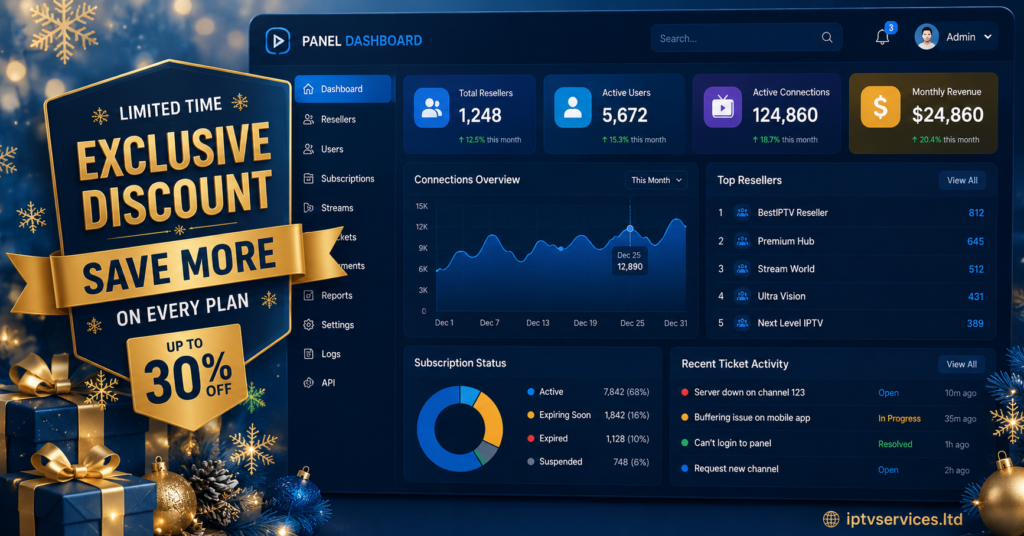
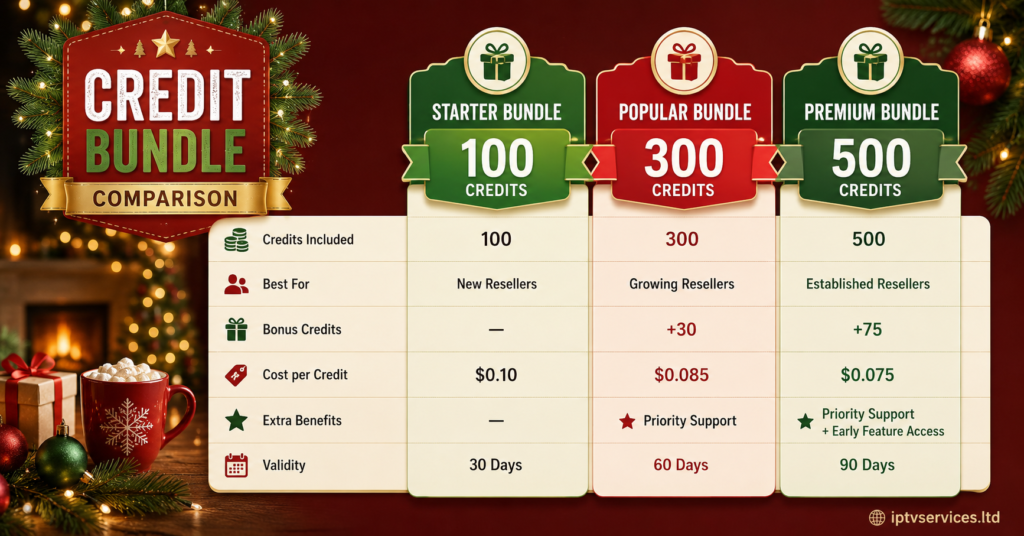
Resellers who understand how IPTV reseller panels work know that credit pricing tiers usually shift in bulk purchase brackets rather than flat percentage discounts. A genuine Black Friday IPTV deal at the panel level often looks like “buy 500 credits, get 100 free” rather than a straight price cut, because that structure protects the provider’s margin while still passing savings downstream.
Reseller Prep Checklist Before the Season Starts
- Audit your current server load headroom against last year’s December peak, not last month’s average
- Confirm your backup uplink provider has capacity reserved, not just theoretically available
- Lock in panel credit pricing with your upstream provider before demand pushes their tiers up
- Pre-write EPG and channel list updates so support tickets do not pile up during the discount window
- Set a hard floor on your discount percentage so margin does not collapse under acquisition volume
- Prepare a churn-prevention message for January, since post-holiday cancellations are predictable and manageable if you plan the retention offer in advance
The Christmas Week Problem: Concurrent Connections and ISP Behavior
Black Friday gets the marketing attention, but Christmas week is where infrastructure actually breaks. Multiple generations of one family are often streaming from the same household router at the same time, on different devices, and ISPs have gotten noticeably more aggressive about deep packet inspection and traffic shaping since 2024. By 2026, AI-assisted traffic classification on the ISP side is fast enough to flag unusual streaming patterns in near real time, which means DNS poisoning and connection drops spike right when demand is highest.
This is the part of Black Friday IPTV deals season that catches new resellers off guard. You can have flawless server capacity and still lose customers to a last-mile ISP issue that has nothing to do with your panel. The fix is not more server power, it is redundancy in delivery paths and clear customer education about router-level troubleshooting before the holiday rush starts.
Pro Tip: Send a short, plain-language troubleshooting message to your entire customer list on December 23rd, before problems start, not after. A proactive message cuts support ticket volume more than any single technical fix you can make that week.
Cheap Infrastructure vs Premium Infrastructure During Peak Season
| Factor | Cheap Infrastructure | Premium Infrastructure |
|---|---|---|
| Backup uplink | Single provider, no failover | Multiple providers with automatic failover |
| Load balancing | Manual, reactive | Automated, pre-scaled for known peaks |
| Buffering under load | Frequent during peak hours | Rare, absorbed by headroom |
| Support ticket volume | Spikes sharply in December | Stays roughly flat year-round |
| Customer retention into January | Weak, high churn | Stronger, fewer cancellations |
Sub-Reseller Strategy: Buying Credits During the Discount Window
Sub-resellers have a narrow but real opportunity during Black Friday IPTV deals season. Bulk credit pricing from upstream panels tends to improve for a limited window, and locking in a larger credit purchase before demand pushes tier pricing back up can meaningfully improve margin for the entire following quarter. The mistake most sub-resellers make is buying reactively, after they have already sold subscriptions at a discounted rate, rather than securing credit stock ahead of the sales push.
A more disciplined approach looks at this from IPTV services infrastructure first: confirm panel uptime history, confirm the provider’s own backup uplink arrangements, and only then negotiate bulk credit pricing. Providers who cannot answer basic infrastructure questions clearly are not providers you want holding your credit stock during the highest-demand week of the year.
What Subscribers Should Actually Watch For
From the household side, Black Friday IPTV deals are not automatically a good deal just because the number looks smaller. A few things worth checking before committing to a discounted annual plan:
- Whether the discount applies to a full year or just the first month, with a price jump after
- How many concurrent connections are actually included versus advertised
- Whether the provider has a visible, responsive support channel, not just a sales page
- Whether the EPG and channel list are current, since outdated guides are a common sign of a neglected panel
Pro Tip: Ask any provider directly how they handle a service interruption during peak hours. A vague answer is a bigger warning sign than the price itself.
Risk Mitigation: Why Backup Uplink Servers Matter More in December
Every operator eventually learns this the hard way. A single uplink server that performs fine in a quiet month becomes a single point of failure the moment concurrent connections triple. Backup uplink servers are not a luxury add-on during Black Friday IPTV deals season, they are the difference between a smooth acquisition period and a wave of refund requests in the first week of January.
The operators who scaled successfully through past holiday seasons treat backup uplinks as part of the discount cost itself. If you are not budgeting for redundant delivery capacity when you plan your Black Friday pricing, the discount is effectively subsidized by degraded service quality, which shows up in churn a few weeks later. As one useful reference point on infrastructure planning, britishseller.co.uk covers similar seasonal capacity planning from a UK market perspective worth reviewing.
Frequently Asked Questions
Are Black Friday IPTV deals actually cheaper than the rest of the year?
Often, yes, particularly on annual plans and bulk reseller credits. The key is checking whether the discount is genuine or a short-term teaser rate that reverts to a higher price after the first billing cycle.
How much extra server capacity should a reseller plan for around Christmas?
Most experienced operators plan for at least double their average concurrent connection load during the week of Christmas Eve through New Year’s Day, based on past-season patterns rather than current monthly averages.
Why do IPTV services buffer more in December even with a good connection?
Household networks are handling more simultaneous streams than usual, and ISP traffic shaping tends to intensify during high-demand periods, both of which can affect stream quality independent of the panel’s own performance.
Can I negotiate better panel credit pricing during Black Friday IPTV deals season?
Yes, this is typically the best window of the year for bulk credit negotiation, since providers are actively trying to move volume. Locking in pricing before the discount period ends usually beats waiting.
Is it worth switching providers just for a Black Friday discount?
Not usually, unless the current provider has ongoing reliability issues. Switching during peak season introduces onboarding risk at the worst possible time; a better window is typically late January once demand has settled.
What should resellers tell customers about January price increases?
Be upfront early. Customers who understand the discount was temporary and see a clear renewal price in writing are far less likely to churn angrily than those who discover a price jump on their card statement.
Do backup uplink servers actually reduce buffering during peak hours?
Yes, meaningfully. Redundant delivery paths absorb the load spikes that single-server setups cannot, which is why premium infrastructure holds up noticeably better during the highest-traffic weeks of the year.
How can sub-resellers avoid running out of credits during the holiday rush?
Purchase bulk credit stock ahead of the sales push rather than reactively, and keep a buffer of at least twenty percent above projected demand based on last year’s December numbers.
Subscriber Checklist
- Confirm whether the discount is annual or a short-term teaser rate
- Check actual concurrent connection limits before buying
- Test the provider’s support responsiveness before the holiday rush, not during it
- Save the renewal price in writing to avoid surprises in January
Reseller Checklist
- Stress-test server capacity against last year’s real December peak
- Confirm backup uplink failover works before launching any discount
- Set a hard margin floor before dropping prices
- Prepare a January retention message in advance
Sub-Reseller Checklist
- Lock in bulk credit pricing before demand pushes tiers higher
- Keep a twenty percent credit buffer above projected demand
- Vet upstream providers on infrastructure transparency, not just price
- Avoid reactive credit purchases after the sales push has already started
Conclusion
Black Friday IPTV deals reward the operators who prepare infrastructure before they touch pricing, not after. The discount itself is the easy part. What separates a strong Q4 from a damaging one is whether backup uplinks, load balancing, and credit stock were sorted out weeks in advance, and whether customers were given honest expectations about what happens after the holiday pricing ends. Explore current IPTV reseller panel services to see how a properly scaled setup handles this season without the usual December scramble.