

An IPTV free trial is a short, time-limited test period that lets a subscriber or reseller evaluate a panel’s stream stability, channel uptime, and support responsiveness before paying for a full subscription or credit package. The real value of an IPTV free trial isn’t the free part, it’s what the test window exposes about the infrastructure behind the panel.
Why an IPTV Free Trial Is the Only Honest Sales Pitch Left
Every panel operator says their service is fast and reliable. An IPTV free trial is the only part of the sales process that can’t be faked with marketing copy. During a trial window, a subscriber or reseller is watching real streams pulled from real uplink servers, not a demo reel or a screenshot. If the panel is running on shared, oversold infrastructure, it shows up almost immediately during peak hours.
This is why experienced resellers treat the IPTV free trial period as a diagnostic tool, not a courtesy. They’re not asking “does it work,” they’re asking “does it hold up under load, does it recover from a dropped connection, and does the EPG stay synced across a full evening of testing.” A trial that only gets tested for ten minutes on a quiet afternoon tells you almost nothing useful.
Pro Tip: Never judge an IPTV free trial during off-peak hours only. Test it during a Friday or Saturday evening when concurrent connections across the panel’s server pool are at their highest. That’s when weak load balancing and thin uplink capacity actually show themselves.
What a Genuine IPTV Free Trial Should Actually Test
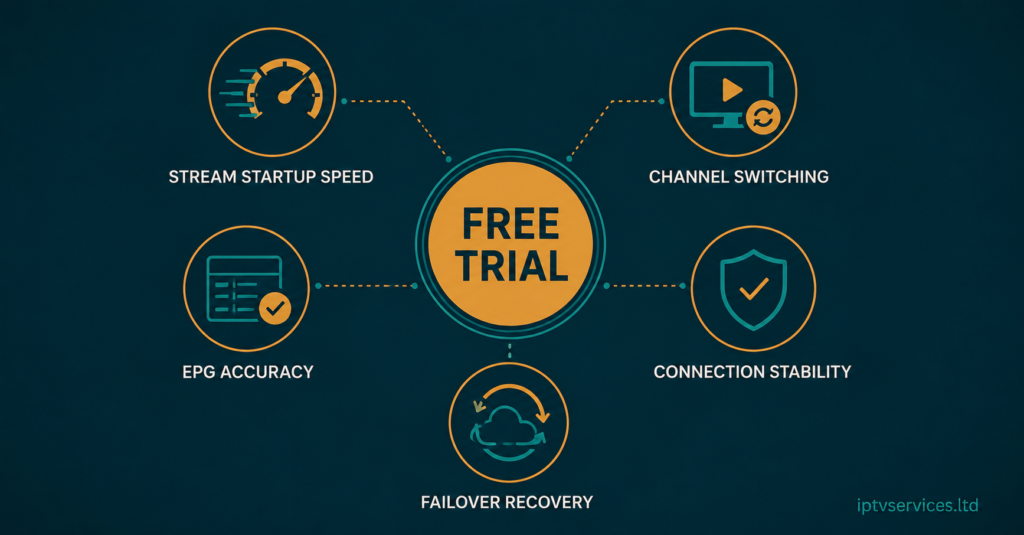
A properly structured IPTV free trial isn’t just “does the channel load.” It should let you evaluate five separate technical layers, each of which affects the long-term experience far more than the channel count ever will.
Stream startup time matters because it reflects how efficient the panel’s CDN routing is. A trial where channels take eight to ten seconds to buffer on first load usually points to a provider running minimal caching infrastructure. Second, watch how the panel behaves during a channel switch. Fast switching with minimal black-screen delay usually means the backend is using adaptive bitrate delivery correctly rather than forcing a full reload on every change.
Third, test the EPG. A free trial with a blank or delayed program guide is a strong signal that the panel is reselling access without properly maintaining its own metadata feeds. Fourth, check for DNS poisoning symptoms, meaning channels that resolve inconsistently depending on your ISP or region. And fifth, test what happens when your connection briefly drops. A well-built panel with proper failover routing reconnects within a few seconds. A poorly built one leaves you stuck on a frozen frame or forces a full app restart.
The Sub-Reseller Angle Most Guides Skip
Most articles about IPTV free trials are written for the end subscriber. Almost none of them talk about how sub-resellers should be using trial credits before committing to a bulk panel purchase. This is a mistake, because sub-resellers carry more risk than subscribers do. A subscriber who gets a bad trial just walks away. A sub-reseller who skips proper trial testing and buys a large credit package upfront is now stuck reselling a weak product to their own customer base.
Before buying credits in bulk, a sub-reseller should run the IPTV free trial across multiple device types, not just one. Test it on an Android box, a Fire Stick, and a smart TV app separately, because panel performance can vary significantly depending on how the client app handles the stream. A panel that performs well through TiviMate but stutters badly through IPTV Smarters Pro is telling you something about how the backend handles different connection protocols, not just app quality.
Pro Tip: Ask the panel operator directly what happens to your trial account’s DNS Poisoning Trends resistance after purchase. If they can’t explain how they route around ISP-level blocking during peak enforcement periods, that’s a red flag about the long-term durability of the service you’d be reselling.
How AI-Driven ISP Blocking Changed What a Trial Needs to Prove in 2026
ISP-level enforcement in 2026 has become more automated and pattern-based than it was even two years ago. Some ISPs now use behavioral detection that flags accounts showing streaming patterns consistent with unauthorized redistribution, rather than relying solely on static IP or domain blacklists. This shift matters directly for anyone evaluating an IPTV free trial, because a trial run today needs to test more than raw speed.
A trial should reveal whether the panel has backup uplink servers ready to reroute traffic if a primary node gets flagged. Panels without redundancy tend to show sudden, unexplained outages a few weeks after a subscriber signs up, well past the point where a short free trial would have caught the problem. This is exactly why testing an IPTV free trial for at least 24 to 48 hours, rather than a single session, gives a far more honest picture of what you’re actually buying into.
Legitimate infrastructure-first providers build their trial period around proving this resilience, not around convincing you the channel count is impressive. A trial with 20,000 “channels” and no failover architecture is worth far less than one with a smaller lineup backed by real redundancy.
Why Panel Credits Behave Differently During Trial Periods
One detail almost nobody explains about an IPTV free trial is how panel credits function once the trial converts into a paid account. Some providers run trial accounts on a completely separate, lighter-weight server pool than their paying customers, which means the trial experience doesn’t actually reflect what you’ll get after upgrading. This is one of the more common complaints resellers raise after committing to a package based on trial performance that later doesn’t match.
Before trusting an IPTV free trial’s results, ask the operator directly whether trial accounts and paid accounts share the same server infrastructure. If they hesitate or give a vague answer, treat the trial results as unreliable. A transparent provider, similar to how British Seller structures its panel documentation for resellers, will tell you exactly which server cluster a trial runs on and confirm whether that matches production.
Pro Tip: Request the panel’s concurrent connection limit during the trial specifically, not just the general marketing number. Some providers cap trial accounts artificially low, which hides how the panel actually performs at scale.
Buffering Under Pressure: What It Actually Signals
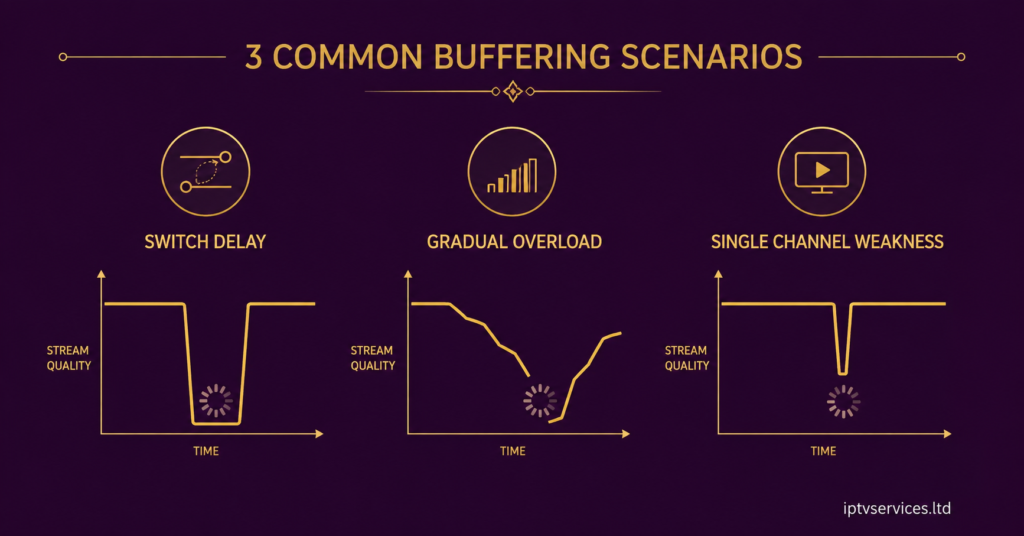
Buffering during an IPTV free trial gets dismissed too quickly as “just internet issues.” In practice, buffering that happens consistently at the same point in a stream, rather than randomly, usually points to a specific infrastructure bottleneck rather than a connection problem on your end.
If buffering happens right at a channel switch, that’s a CDN routing delay. If it happens gradually worse over a viewing session, that points to thermal throttling or overloaded uplink servers as more users log on. If it happens only on specific channels and not others, that channel is likely being pulled from a weaker upstream source than the rest of the lineup. Learning to read these patterns during a trial, rather than just noting “it buffered,” is what separates a useful evaluation from a wasted one.
A reseller managing their own downstream panel through resources like IPTV Services’ panel guide should apply this same diagnostic approach when testing supplier panels before reselling credits to their own customer base.
Trial-to-Paid Conversion: Where Most Resellers Get Burned
The gap between a strong IPTV free trial and a disappointing paid subscription usually comes down to one thing: scale. A panel can handle fifty trial accounts on quiet servers without issue. The same panel under two thousand paying accounts during peak hours is a completely different technical challenge. This is why load balancing quality matters more than any single trial session can reveal on its own.
Ask about the provider’s growth history. A panel that’s been stable for three years with a consistent customer base has already been tested at scale by the market. A brand-new panel offering an unusually generous IPTV free trial with no track record carries more risk, even if the trial itself performs flawlessly.
For anyone building a reselling business, checking a provider’s reseller panel operations page for details on their infrastructure setup before committing credits is a reasonable diligence step, similar to how you’d vet any B2B software vendor.
Frequently Asked Questions
How long should an IPTV free trial last to be useful?
A trial of at least 24 to 48 hours gives a far more reliable picture than a single session. Short trials under an hour rarely expose peak-hour load issues, failover behavior, or EPG sync problems, which are the details that matter most once you’re a paying customer.
Is it normal for an IPTV free trial to require a device MAC address?
Yes, many panels use MAC address binding during trials to prevent credential sharing across multiple devices. This is a standard access control method and isn’t unusual on its own, though you should confirm the panel allows you to update the bound device if you switch hardware later.
Can I test an IPTV free trial on more than one device at once?
Most trial accounts are limited to a single concurrent connection specifically to prevent abuse. If you need to test multiple devices, ask the provider whether they can issue a short multi-device trial, since testing across TiviMate, IPTV Smarters Pro, and a smart TV app separately gives a more complete picture.
Why does my IPTV free trial work fine at night but buffer during the day?
This usually points to peak-hour load on the panel’s uplink servers rather than your own connection. If buffering appears consistently during high-traffic evening hours, it’s a sign the panel may be oversold relative to its server capacity.
What should a reseller look for differently than a regular subscriber during a trial?
A reseller should test concurrent connection limits, credit-to-account conversion behavior, and whether trial accounts run on the same infrastructure as paid accounts. A subscriber mainly cares about picture quality and channel uptime, but a reseller is effectively testing the product they’ll be selling downstream.
Does a smooth IPTV free trial guarantee good service after I upgrade?
Not always. Some providers run trial accounts on lighter server loads than paying customers experience, so a smooth trial isn’t a full guarantee. Confirming whether trial and paid accounts share the same server cluster is the best way to reduce this risk before committing.
Is it a red flag if a provider won’t offer any IPTV free trial at all?
It’s worth treating cautiously. Providers confident in their infrastructure generally have no reason to avoid a short trial period. That said, some established panels skip trials in favor of short paid test periods instead, which can still be a reasonable middle ground if the cost is low.
What’s the biggest mistake people make during an IPTV free trial?
Testing only during quiet hours and only on one device. This gives an incomplete picture of how the panel performs under real conditions, which is exactly when infrastructure weaknesses tend to surface.
Success Checklist
For Subscribers
- Test the trial during peak evening hours, not just daytime
- Check EPG accuracy across at least a few different channel categories
- Note buffering patterns rather than just buffering frequency
- Confirm reconnection speed after a brief connection drop
For Resellers
- Test the panel across at least two different device apps
- Ask directly whether trial and paid accounts share server infrastructure
- Confirm the provider’s backup uplink and failover setup before buying credits
- Review the provider’s documented reseller panel process before committing
For Sub-Resellers
- Run trial credits across multiple downstream test accounts before bulk purchase
- Verify concurrent connection limits match what you plan to resell
- Ask about DNS poisoning resistance and rerouting history
- Confirm credit expiration terms before scaling your own customer base
An IPTV free trial is worth far more than its price tag suggests, but only if it’s tested properly. Treat it as a technical audit, not a formality, and it will tell you almost everything you need to know before a single credit or subscription payment changes hands.