
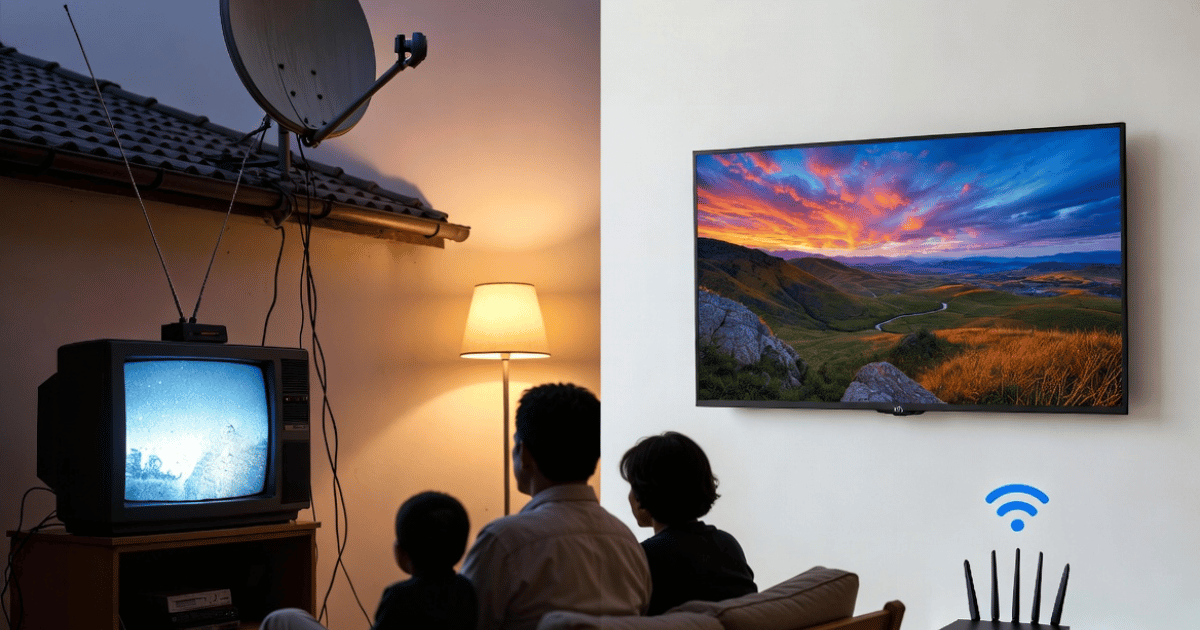
IPTV vs Traditional Broadcasting: The 2026 Operator’s Real Breakdown
The debate around IPTV vs traditional broadcasting used to be straightforward. One required a satellite dish or aerial. The other needed an internet connection. The conversation has become significantly more complex in 2026 — and the stakes are higher for everyone involved.
For households, the choice determines content access, picture quality, and what happens to their viewing when infrastructure fails. For resellers, understanding the structural differences between IPTV vs traditional broadcasting is not academic — it directly shapes how you position your service, handle objections, and retain subscribers who are moving away from conventional setups for the first time.
This is not a comparison designed to sell you on one side. It is an operational breakdown of how each model actually functions, where each fails, and what the shift means for anyone building a commercial IPTV operation in 2026.
How IPTV vs Traditional Broadcasting Differs at the Infrastructure Level
Traditional broadcasting — whether satellite, terrestrial, or cable — operates on a push model. The broadcaster transmits a signal continuously across a fixed spectrum. Every viewer with the correct hardware receives the same signal simultaneously. There is no personalisation, no on-demand flexibility, and no two-way communication between the broadcaster and the viewer.
IPTV operates on a pull model. The viewer’s device requests a specific stream from a server. That server delivers the content over an IP network directly to that device. The infrastructure relationship is entirely different — and so are the failure modes.
In traditional broadcasting, if the signal transmitter fails, every viewer in that coverage area loses service simultaneously. Recovery requires physical infrastructure repair. In IPTV, if a primary server fails, automatic failover to a backup node can restore service in under three seconds — provided the infrastructure is built correctly. That distinction alone explains why enterprise operations are migrating toward IP delivery at scale.
Pro Tip: When a subscriber who has switched from satellite asks why they occasionally experience buffering they never had before, the honest answer is that IPTV failure modes are different, not more frequent. Satellite buffers zero — then fails completely. IPTV degrades gradually, which feels more visible even when total uptime is higher.
Signal Delivery: Where Traditional Broadcasting Still Holds Ground
Acknowledging this is important for credibility. Traditional broadcasting has a genuine technical advantage in one specific scenario: areas with poor or inconsistent internet connectivity.
A satellite signal does not depend on local network infrastructure. In rural locations where broadband speeds are unreliable, a traditional broadcast signal delivers consistent picture quality regardless of what the local exchange is doing at peak time. This is a real limitation of IPTV that resellers in coverage areas with patchy connectivity need to address honestly rather than oversell past.
The comparison shifts decisively in urban and suburban environments with fibre connectivity. On a stable 50 Mbps+ sustained connection, IPTV delivers:
- On-demand access to content libraries that no traditional broadcast model can replicate at equivalent cost
- Multi-device simultaneous viewing without additional hardware per screen
- Instant channel switching without physical dish alignment or signal strength dependencies
- International content access that satellite packages cannot provide without expensive add-on subscriptions
The infrastructure advantage of traditional broadcasting is geographic and narrowing. Fibre rollout continues to reduce the coverage gap annually. Within five years, the scenario where satellite outperforms IPTV on reliability grounds will apply to a significantly smaller user base.
IPTV vs Traditional Broadcasting: Content Delivery Speed and HLS Latency
This is where the comparison gets technically specific — and where resellers frequently encounter subscriber complaints rooted in a genuine difference between the two delivery models.
Traditional live broadcasts carry a glass-to-glass latency of approximately 1–3 seconds. The moment something happens on a pitch or a stage, it reaches a satellite receiver within that window. This is the benchmark that live sports viewers have calibrated to over decades.
IPTV streams delivered over HLS protocol carry a baseline latency of 2–8 seconds on well-optimised infrastructure, and 8–15 seconds on budget platforms with inadequate server configuration. For standard entertainment content, this difference is invisible. For live sports, it creates a specific and irritating problem: a subscriber watching a match via IPTV receives the goal notification on their phone before they see it on screen.
Understanding how IPTV reseller panels work at the infrastructure level — specifically how HLS segment size, CDN configuration, and server proximity affect latency — is the difference between a panel that competes with traditional broadcast timing and one that consistently frustrates sports viewers.
Broadcast Resilience vs IPTV Redundancy: A Direct Comparison
| Factor | Traditional Broadcasting | IPTV Infrastructure |
|---|---|---|
| Signal delivery model | Push (continuous broadcast) | Pull (on-demand per device) |
| Primary failure mode | Transmitter/satellite fault | Server overload or ISP block |
| Recovery time | Hours to days (physical repair) | Seconds (automated failover) |
| Live sports latency | 1–3 seconds | 2–8 seconds (premium) / 8–15s (budget) |
| Content library | Fixed schedule | On-demand + live simultaneous |
| Multi-device support | One signal per hardware unit | Unlimited concurrent streams |
| Geographic limitation | Coverage area dependent | Internet-dependent globally |
| ISP interference risk | None | Active in 2026 via DPI |
| Personalisation capability | None | Full (EPG, VOD, catch-up) |
Why AI-Driven ISP Enforcement Changes the IPTV vs Traditional Broadcasting Equation
Traditional broadcasting operates entirely outside ISP jurisdiction. A satellite signal bypasses the internet entirely — there is nothing for an ISP to intercept, throttle, or block. This is a structural immunity that traditional broadcasting holds permanently.
IPTV traffic is internet traffic. In 2026, that means it operates within an enforcement environment that did not exist five years ago. Major ISPs deploy AI-pattern recognition systems that identify HLS stream signatures, port behaviour, and traffic clustering associated with IPTV delivery. The result is selective throttling, DNS poisoning, and connection interruption that targets IPTV streams specifically without affecting other internet usage on the same connection.
For resellers, this is not a reason to position IPTV defensively. It is a technical reality that requires operational preparation. Platforms with active DNS rotation, backup uplinks across multiple ASNs, and automatic rerouting absorb enforcement events without subscriber-visible disruption. The IPTV services that survive sustained ISP enforcement are those built around redundancy from the architecture level — not patched reactively after the first block.
Subscribers switching from traditional broadcasting need to understand that this enforcement landscape exists and that their provider’s infrastructure quality is the primary variable in whether it affects their experience.
Cost Structure: IPTV vs Traditional Broadcasting for Household Subscribers
Traditional broadcasting costs are front-loaded with hardware and installation, then recurring through rigid subscription tiers. A satellite setup requires dish installation, a receiver box, and a contract with a fixed channel package — typically at a premium price point for access to sports or international content. Upgrading the package means upgrading the contract. Adding a second screen means adding hardware.
IPTV cost structure operates differently. A single subscription credential can be used across multiple devices simultaneously — smart TV, phone, tablet, laptop — without additional hardware. Content access, including premium sports and international programming, is included within a single flat subscription rather than gated behind tiered package upgrades.
For resellers, this cost efficiency is a powerful conversion argument for subscribers currently paying traditional broadcast premiums. The monthly spend comparison almost always favours IPTV significantly. The conversation to have is not about price alone, though — it is about combining that cost advantage with the infrastructure quality argument, specifically the service quality delivered by a well-built panel versus the premium traditional broadcasters charge for equivalent content access.
Pro Tip: When a prospect is comparing their current traditional broadcast bill to your IPTV offering, do not just quote the price difference. Walk them through what they are currently not receiving — multi-device access, international content, catch-up flexibility — at any price. The value gap is larger than the cost gap, and subscribers who understand that retain far longer.
Device Ecosystem: How IPTV vs Traditional Broadcasting Serves Modern Households
Traditional broadcasting requires dedicated hardware at each viewing point. A receiver box for the living room television. A separate subscription or hardware unit for the bedroom. No native support for mobile viewing, tablet access, or laptop streaming without workarounds that the broadcaster does not officially support.
IPTV is device-agnostic by design. A single set of credentials works across smart TVs, Android boxes, Firestick devices, iOS and Android phones, tablets, and web browsers — simultaneously, on the same subscription, without additional hardware costs. For households that have moved beyond the single living room television model, this flexibility is not a minor convenience. It is a fundamental capability difference.
The device compatibility consideration that resellers need to communicate clearly involves codec support. H.265 streams require hardware decoding capability — older smart TV models and basic streaming sticks may not support it natively, causing CPU overload and stuttering rather than clean playback. Identifying the subscriber’s device ecosystem before activation and recommending appropriate stream quality settings prevents the most common post-signup complaints.
Resellers who review the IPTV reseller services available for device compatibility guidance build onboarding processes that reduce technical support contacts in the first two weeks significantly.
What Traditional Broadcasting Does Better: The Honest Reseller’s Assessment
Credibility in the IPTV vs traditional broadcasting conversation requires acknowledging where traditional models retain genuine advantages — not just in rural connectivity scenarios already covered.
Traditional broadcasting has a regulatory stability that IPTV does not. A satellite subscription operates under a clear contractual and legal framework. There are no ISP enforcement events, no DNS poisoning risks, and no server-side failures. For a household that has never experienced IPTV and values frictionless, completely passive viewing — turn on, watch, no troubleshooting — the traditional model delivers exactly that promise reliably.
The EPG (Electronic Programme Guide) experience on traditional broadcasting is also typically more polished. Major broadcasters have invested heavily in guide accuracy, programme metadata, and catch-up integration within their own ecosystem. IPTV EPG quality varies enormously — a panel claiming 95%+ EPG accuracy is delivering a competitive product; one running unmonitored EPG feeds creates constant low-level subscriber frustration.
Resellers who can honestly address these comparative weaknesses in their sales conversations — rather than ignoring them — build credibility that converts better and retains longer. Subscribers who feel they received an honest assessment before purchasing are significantly less likely to churn when they encounter any friction post-sale.
According to operational benchmarks published by britishseller.co.uk on IPTV reseller infrastructure standards, EPG accuracy and stream monitoring are core infrastructure metrics — not optional extras — for any panel competing at a professional level against traditional broadcast quality expectations.
Frequently Asked Questions
What is the main technical difference between IPTV and traditional broadcasting?
Traditional broadcasting pushes a continuous signal to all receivers simultaneously over a fixed spectrum — satellite, aerial, or cable. IPTV uses a pull model where each device requests its stream individually from a server over an IP network. This means IPTV can be personalised and on-demand, but it also means performance depends on internet connection quality and server infrastructure rather than signal strength.
Is IPTV picture quality better than traditional broadcasting in 2026?
On a stable fibre connection with a premium IPTV panel, 4K HDR picture quality exceeds what most traditional broadcast packages deliver at equivalent price points. However, picture quality on IPTV is variable — it degrades with internet congestion or server overload. Traditional broadcasting delivers consistent quality within its resolution ceiling regardless of local network conditions.
Why does IPTV have more latency than traditional broadcasting on live sports?
Traditional broadcasts carry 1–3 seconds of glass-to-glass latency because the signal travels a direct broadcast path. IPTV uses HLS protocol, which segments the stream into chunks for delivery over the internet. Each chunk introduces processing delay. Premium IPTV infrastructure achieves 2–5 second latency; budget platforms run 8–15 seconds. The gap is real and most noticeable during live sports events.
Can IPTV completely replace traditional broadcasting for a family household?
For households with reliable broadband above 25 Mbps sustained, IPTV covers everything traditional broadcasting provides plus significantly more — international content, multi-device access, on-demand libraries, and catch-up functionality. The only genuine gap remains in locations with inconsistent internet infrastructure where satellite signal stability outperforms available broadband reliability.
How does ISP blocking affect IPTV but not traditional broadcasting?
Traditional broadcasting bypasses internet infrastructure entirely, making it immune to ISP enforcement. IPTV traffic travels over the internet and is subject to deep packet inspection, DNS poisoning, and selective throttling. In 2026, AI-driven ISP systems can identify IPTV stream signatures and throttle them specifically. Resellers on panels with active DNS rotation and multi-uplink failover absorb these events without subscriber-visible disruption.
What should a reseller tell subscribers switching from traditional broadcasting to IPTV?
Set expectations honestly: IPTV delivers more content, more flexibility, and lower cost — but the failure mode is different. Traditional broadcasting either works perfectly or fails completely. IPTV can degrade gradually. Explain the importance of a wired connection, provide a basic troubleshooting guide at onboarding, and confirm infrastructure quality upfront. Subscribers who understand what they are getting retain far better than those oversold on a frictionless promise.
Is IPTV vs traditional broadcasting a relevant comparison for resellers to use in sales conversations?
Yes, and it is one of the most effective conversion tools available. The majority of potential subscribers currently paying for a traditional broadcast package are spending significantly more for less content access and zero device flexibility. Walking a prospect through the direct cost and capability comparison — honestly, including IPTV’s limitations — positions the reseller as a trusted advisor rather than a salesperson, which consistently produces better long-term retention.
How does multi-server failover change the reliability comparison between IPTV and traditional broadcasting?
Traditional broadcasting cannot fail over — if the transmitter goes down, recovery requires physical repair measured in hours or days. IPTV infrastructure with multi-server failover automatically reroutes traffic to a backup node within seconds of any primary server disruption. For resellers on well-built panels, IPTV’s uptime in practice can exceed what a traditional broadcast setup delivers over a comparable period.
Reseller Success Checklist: Winning the IPTV vs Traditional Broadcasting Conversation
Sales Positioning — Build a direct cost comparison between a typical traditional broadcast package and your IPTV offering — include hardware, installation, and multi-device costs in the comparison, not just monthly subscription price — Document every content category your service covers that the equivalent traditional package does not — international channels, VOD depth, sports coverage breadth — Prepare an honest one-paragraph acknowledgement of where traditional broadcasting holds a genuine advantage — rural connectivity, zero-configuration viewing — and have it ready for objection handling
Subscriber Onboarding for Switchers — Identify each new subscriber’s current setup — satellite, cable, or terrestrial — and tailor the expectation conversation to the specific differences they will notice — Provide a device compatibility checklist before activation to prevent H.265 playback issues on legacy hardware — Schedule a check-in contact specifically during a live sports event in the first week — this is when latency differences become real to switchers
Infrastructure Readiness — Confirm your panel’s HLS latency specification before promoting live sports as a primary selling point — Verify EPG accuracy figures — subscribers migrating from traditional broadcasting have high EPG expectations set by years of polished guide interfaces — Ensure multi-server failover is active and tested — a single-server failure event in the first month of a switcher’s subscription produces permanent churn
Ongoing Retention — Monitor concurrent stream load during major live events — this is the performance window that determines whether IPTV vs traditional broadcasting comparison stays in your favour — Track support contacts related to latency or buffering specifically from recent switchers — these are the earliest churn signals in this segment — Review your infrastructure capacity against your subscriber growth rate quarterly — infrastructure that handled 100 subscribers does not automatically scale to 300 without deliberate provisioning review